
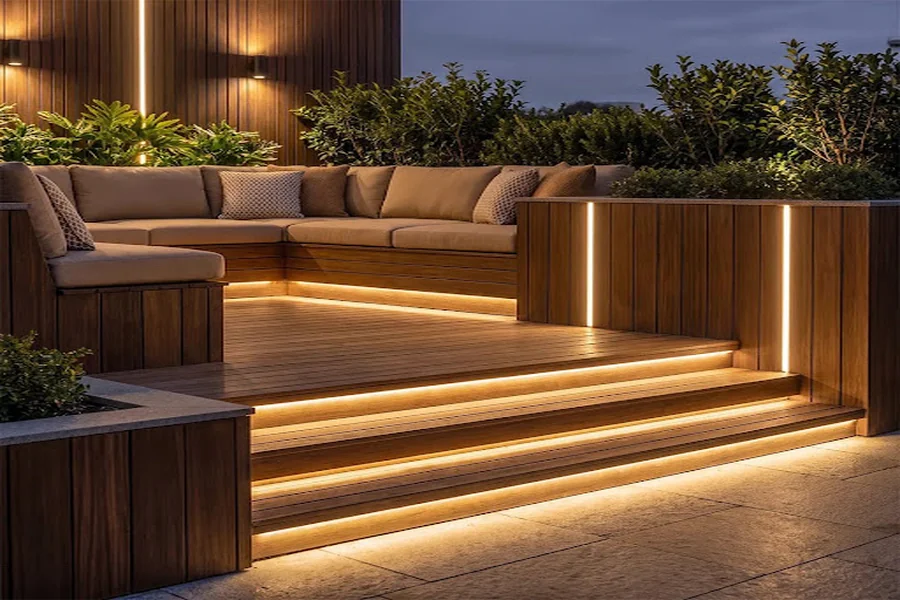
Outdoor lighting works best when different fixtures perform different jobs. A path needs clear guidance, a patio needs comfortable ambient light, steps need enough visibility for safe movement, and trees or architectural features may only need a small amount of accent lighting.
This is why relying on one bright floodlight rarely creates the best result. A more balanced approach is to combine lower-level landscape fixtures with integrated linear lighting. Low-voltage lights can provide dependable illumination around paths and garden areas, while LED strip lights can be concealed beneath steps, benches, railings, and architectural edges.
Used together, these two lighting types can create an outdoor space that feels more intentional without becoming excessively bright.
Combining concealed linear lighting with lower-level landscape fixtures can provide both practical visibility and a more layered nighttime atmosphere.
Start With the Areas That Need Reliable Visibility
Before deciding where decorative lighting should go, identify the routes people regularly use after dark.
Walkways, steps, gates, driveways, and the route between the house and patio usually deserve attention first. These areas should provide enough light for people to understand where they are walking without forcing them to look directly into a bright source.
Low-voltage fixtures are especially useful in these locations because they can be distributed across several points in the landscape rather than depending on one powerful light mounted on the house.
Instead of trying to illuminate every inch of the path, place fixtures around corners, changes in elevation, intersections, and other areas where visibility matters most.
Use Low Voltage Lighting as the Foundation
A low-voltage outdoor system can provide the functional foundation of a larger lighting plan.
Depending on the fixture type, it can illuminate pathways, garden beds, trees, walls, and other outdoor features while operating at a lower voltage than standard line-voltage household systems.
Homeowners comparing Outdoor Low Voltage Lights can look at path fixtures, spotlights, landscape lights, and other formats according to the areas that need dependable illumination.
The biggest advantage is flexibility. Rather than installing one fixture for the whole yard, several lower-output lights can create smaller zones of controlled illumination.
Add LED Strips Where You Want the Light Source to Disappear
LED strip lighting performs a different role.
Instead of standing visibly in the garden, strips can often be integrated beneath architectural surfaces. They can sit under stair edges, built-in benches, railings, counters, deck borders, or other features where the source remains hidden while the glow stays visible.
This can give an outdoor area a cleaner and more contemporary appearance.
When comparing Outdoor LED Strip Lights, homeowners should consider weather protection, voltage, installation location, control options, and whether the strip will be directly visible or concealed behind a surface.
Use LED Strips to Make Steps Easier to Read
Steps are one of the strongest applications for concealed linear lighting.
During the day, the difference between one level and another is obvious. At night, especially when the deck and steps use similar materials, those edges can become much harder to see.
A strip positioned beneath a stair nosing or along a nearby architectural edge can define the change in level without requiring a bright overhead fixture.
The light should remain controlled. If individual LEDs are directly visible from normal walking positions, the result may create glare instead of improving visibility.
Using a channel, diffuser, or concealed mounting location can help create a smoother line of light.
Let Path Lights Handle Movement Through the Yard
LED strips are useful around architecture, but they are not always the best solution for open garden paths.
Low-voltage path fixtures can provide more natural guidance through planting areas because the light is positioned closer to the route and can be spaced according to the landscape.
Avoid placing identical lights directly opposite each other at perfectly regular intervals unless the garden is highly formal. In many residential landscapes, staggered placement around curves and planting feels more natural.
The goal is to create overlapping pools of soft illumination rather than one uninterrupted runway of light.
Use Spotlights for Trees and Architectural Features
Once walking routes are comfortable, accent lighting can bring selected features back into view.
A low-voltage spotlight beneath a mature tree can reveal its trunk and canopy. Another fixture may highlight a stone wall, garden sculpture, or architectural column.
Choose only a few focal points. Lighting every plant equally can make the garden look flat because nothing remains visually important.
A softly illuminated tree farther from the patio can be especially effective because it creates visual depth beyond the immediate seating area.
Bring LED Strip Lighting Into the Seating Zone
Outdoor living spaces often need softer light than paths and entrances.
LED strips installed beneath built-in seating can create a floating effect while adding gentle ambient illumination close to the ground. Similar lighting beneath an outdoor counter or along the edge of a deck can help define the space without introducing more visible fixtures.
This type of light works particularly well when combined with low-voltage landscape fixtures around nearby plants.
The seating area receives a soft architectural glow, while the surrounding garden remains visible instead of disappearing completely into darkness.
Do Not Make Every Light the Same Brightness
A layered lighting plan works because different areas receive different levels of illumination.
Steps and key walking routes may need more visibility. Seating areas can remain softer, while decorative tree lighting may only need enough output to reveal shape and texture.
If every fixture operates at the same apparent brightness, the yard can lose depth.
Contrast helps the eye understand what matters. Brighter areas naturally become destinations while darker areas provide visual rest.
Keep Color Temperature Consistent
Combining two lighting systems can look disjointed if the color of the light is noticeably different.
Warm white lighting is often comfortable in residential outdoor areas because it works naturally with timber, stone, brick, foliage, and outdoor furniture.
If warm LED strips are installed beneath a deck but nearby path lights appear cool and blue, the difference can make the outdoor space feel less coordinated.
Before purchasing fixtures, compare their stated color temperatures and consider the existing porch or wall lighting around the house.
Plan Power and Wiring Before Construction Is Finished
If you are building a new patio, deck, staircase, retaining wall, or outdoor kitchen, plan the lighting before the finished surfaces are complete.
Early planning makes it easier to conceal cables, locate transformers and power supplies, install mounting channels, and provide access for future maintenance.
This is especially important with LED strips because a clean installation often depends on having an appropriate concealed route for power connections.
Low-voltage landscape lighting also requires thoughtful cable routing. Permanent outdoor electrical work should follow applicable local requirements, and professional installation may be appropriate depending on the complexity of the project.
Use Separate Controls for Different Lighting Layers
The entire backyard does not need to operate as one lighting zone.
Path lighting may be useful every evening, while decorative LED strips around the patio only need to operate when the space is being used. Landscape accents can turn off later, and secondary areas may use motion controls.
Separate zones provide more flexibility and prevent homeowners from illuminating the whole property just to use one small area.
Where compatible, timers, dimming, and smart controls can make the system even more responsive to different activities.
Choose Products Designed for Outdoor Conditions
Outdoor electrical components may be exposed to rain, humidity, irrigation, dust, heat, cold, and ultraviolet light.
Do not assume that an LED strip suitable for an indoor cabinet will also work beneath an exposed deck. The strip, connectors, controller, power supply, and other system components all need to be suitable for their installation environment.
The same applies to low-voltage landscape fixtures. Check outdoor ratings, mounting requirements, electrical specifications, and exposure conditions before installation.
Final Thoughts
Outdoor LED strip lights and low-voltage landscape fixtures are most effective when they are used together rather than asked to perform the same job.
Let low-voltage fixtures handle paths, trees, planting areas, and other places where directional light is useful. Use concealed LED strips around steps, deck edges, seating, and architectural details where a continuous line of light can improve visibility or atmosphere.
Keep brightness controlled, maintain a consistent light color, separate different zones where practical, and leave enough darkness for the landscape to retain depth.
When each lighting layer has a clear purpose, the result can feel safer and more polished without requiring the backyard to be filled with visible fixtures or excessive brightness.