
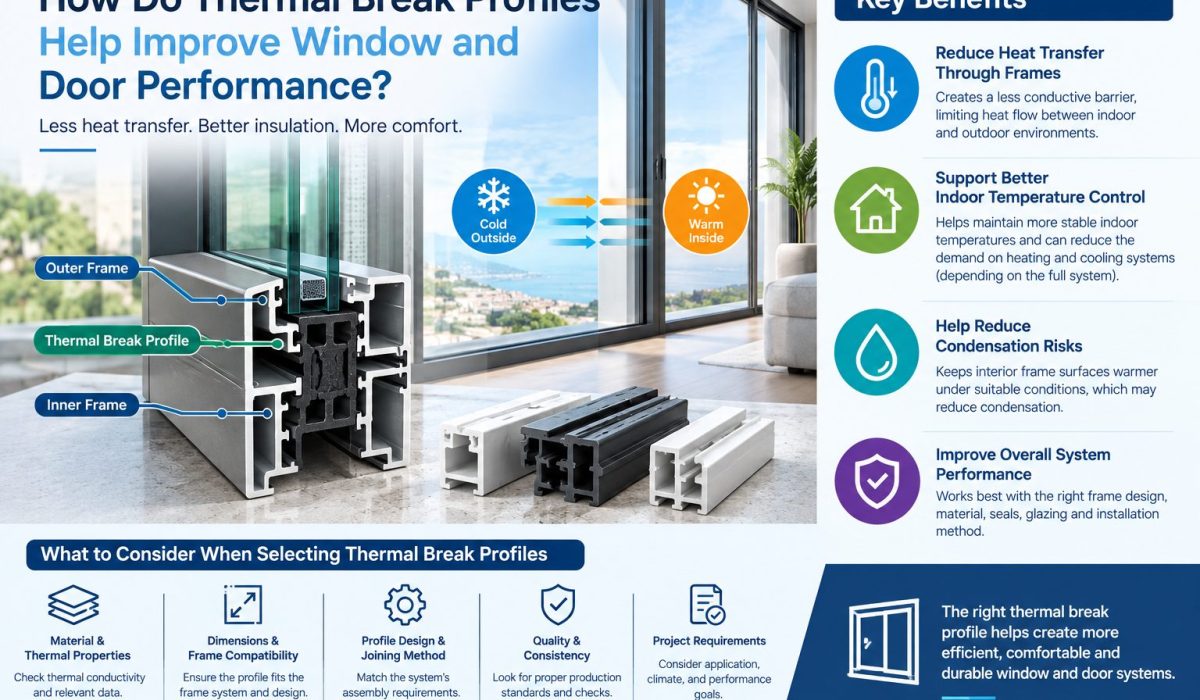
Thermal break profiles help improve window and door performance by reducing heat transfer through frame systems. They can support better thermal insulation, improve indoor temperature control, and help reduce condensation when used as part of a suitable window or door design. Choosing the right thermal break profiles for window and door systems depends on the frame design, material requirements, building conditions, and intended application. Understanding how these profiles work helps manufacturers, contractors, and building product suppliers make better decisions for their projects.
What Are Thermal Break Profiles?
Thermal break profiles are components designed to reduce the transfer of heat between the inner and outer parts of a window or door frame. They create a barrier between sections that would otherwise allow heat to pass through more easily.
They are commonly associated with window and door systems designed to improve thermal performance. Depending on the system, a thermal break may use a material with lower thermal conductivity between metal frame sections.
The design, material, and fit of the profile all affect how well it performs. A suitable profile must match the frame system and meet the project’s technical requirements.
How Do Thermal Break Profiles Improve Window and Door Performance?
1. Reduce Heat Transfer Through Frames
Window and door frames can allow heat to move between the inside and outside of a building. In warm weather, outside heat can enter through the frame. In colder conditions, indoor heat can escape.
Thermal break profiles help limit this transfer by creating a less conductive section within the frame assembly. This can support better thermal performance when combined with suitable glazing, seals, and installation methods.
For commercial buildings, offices, and other properties, reducing unwanted heat transfer can help support a more stable indoor environment.
2. Support Better Indoor Temperature Control
Indoor temperature depends on several factors, including the building design, insulation, glazing, ventilation, and local climate. Window and door frames are one part of this overall system.
Thermal break window profiles can help reduce heat movement through the frame, supporting more consistent indoor temperatures. This may also reduce some of the demand placed on heating or cooling systems, depending on the building and its overall design.
However, thermal break profiles alone cannot guarantee lower energy bills. Their contribution depends on the complete window or door assembly.
3. Help Reduce Condensation Risks
Condensation can form when warm, moist indoor air meets a cold surface. Window and door frames may become cold enough for moisture to collect, particularly in buildings with high indoor humidity or poor ventilation.
By reducing heat transfer through the frame, a well-designed thermal break system can help keep interior frame surfaces warmer under suitable conditions. This may reduce the risk of condensation.
The result also depends on indoor humidity, ventilation, outdoor temperature, glazing performance, and installation quality. Thermal breaks should therefore be considered as one part of a wider moisture-control approach.
For more information, read about how thermal breaks help prevent moisture-related problems.
4. Improve the Overall Performance of Window and Door Systems
Thermal break profiles can contribute to the thermal performance of modern window and door systems. However, their effectiveness depends on more than the profile alone.
The frame design, profile dimensions, material properties, joining method, seals, and glazing all influence the final result. Poorly matched components or gaps around the frame can reduce the benefits of a thermal break.
Manufacturers should assess the complete system rather than selecting a profile based on one feature.
Where Are Thermal Break Profiles Used?
Thermal break profiles may be used in window and door systems where reducing heat transfer through the frame is an important design goal.
Common application areas include:
- Residential buildings, where thermal performance and indoor comfort are important.
- Commercial buildings, including offices and retail properties.
- Façade and window systems, where frame performance forms part of the building envelope.
- Energy-conscious construction projects, where designers aim to manage heat transfer through the building structure.
The exact profile design and material requirements vary by application. Some systems use polyamide or other specialised materials between metal sections, while custom plastic extrusion profiles may serve particular design functions. The suitable choice depends on the frame system and its technical specifications.
What Should Manufacturers Consider When Selecting Thermal Break Profiles?
Choosing a suitable profile requires a clear understanding of the intended application and the complete frame design.
Material and Thermal Properties
Review the material’s thermal conductivity and other relevant properties. These details help determine whether the profile is suitable for the intended thermal performance requirements.
Do not assume that every plastic profile will provide the same level of insulation. Material selection should be based on technical data and the design of the final assembly.
Dimensions and Frame Compatibility
The profile must match the dimensions and joining requirements of the window or door system. Check the required shape, thickness, length, tolerances, and connection details.
For custom designs, technical drawings and clear measurements can help the manufacturer assess the requirements before production.
Mechanical and Environmental Requirements
The profile may need to withstand installation forces, repeated use, temperature changes, moisture, or exposure to sunlight, depending on its position and application.
Manufacturers should identify the relevant conditions and confirm that the selected material is suitable for them.
Production Consistency
For commercial manufacturing, consistent dimensions and quality are important. A profile that varies between production batches may create fitting or assembly problems.
When sourcing custom thermal break extrusion profiles, ask about sample availability, dimensional checks, production capacity, and lead times. These details help purchasing teams assess whether a supplier can meet the project requirements.
How Does M3 Extrusion Support Custom Profile Requirements?
M3 Extrusion is an Indian manufacturer of customised plastic extrusion profiles for industrial and commercial applications, with more than 13 years of manufacturing experience. The company produces profiles according to customer drawings, specifications, dimensions, and bulk production requirements.
For businesses developing window, door, and other industrial components, clear technical specifications help determine whether a custom profile is suitable for the intended design. M3 Extrusion can review customer requirements and discuss sample production before bulk manufacturing.
Customers considering a custom profile should provide the intended application, drawings, dimensions, material requirements, and expected quantity for assessment. Any thermal performance requirement should be clearly specified so that the proposed design can be evaluated appropriately.
Frequently Asked Questions
1. What is the main purpose of thermal break profiles?
Their main purpose is to reduce heat transfer between sections of a window or door frame. This can support better thermal insulation and indoor temperature control when the profile is part of a suitable system.
2. Do thermal break profiles make windows more energy-efficient?
They can contribute to improved thermal performance by limiting heat transfer through the frame. Overall energy efficiency also depends on glazing, seals, installation, ventilation, and the building’s design.
3. Can thermal break profiles help reduce condensation?
They may reduce condensation risk by helping keep interior frame surfaces warmer. However, condensation also depends on indoor humidity, ventilation, outdoor conditions, and the performance of the complete window or door assembly.
4. Are thermal break profiles used in aluminium windows?
Yes. Many thermally broken aluminium window systems use a lower-conductivity material between sections of the aluminium frame. The profile design must be compatible with the particular system.
5. Can plastic extrusion profiles be customised for thermal break applications?
Custom plastic extrusion may be suitable for certain thermal break applications, depending on the design, material properties, dimensions, and performance requirements. The proposed profile should be assessed against the needs of the complete assembly.
6. What information should I provide when requesting a custom thermal break profile?
Provide technical drawings, dimensions, material requirements, intended application, relevant performance specifications, and expected order quantity. This information helps the manufacturer review the design and discuss production feasibility.
Summary
Thermal break profiles help improve window and door performance by reducing heat transfer through frame systems. They can support indoor temperature control, contribute to better thermal insulation, and help reduce condensation risks when the complete assembly is designed correctly.
The right profile depends on material properties, dimensions, frame compatibility, environmental conditions, and production consistency. Manufacturers and project buyers should review these factors before choosing a profile for a specific application.
M3 Extrusion supports B2B customers with customised plastic extrusion profiles made to their technical specifications. Sharing clear drawings and application requirements is a practical first step when assessing a custom profile.
Discuss Your Custom Profile Requirements
If your business needs customised plastic extrusion profiles for window, door, or industrial applications, contact M3 Extrusion to discuss your drawings, dimensions, and production requirements.